Bradford District Prevention and Early Help Strategy 2022-2025
‘Supporting Families – earlier, easier and nearer’
Contents
- Foreword
- What do we mean by Prevention and Early Help and Family Hubs?
- Why is prevention and early help important?
- The context across the Bradford District 2021
- Our local partnership vision for prevention and early help delivered through Family Hub sites and networks
- How we will use evaluation and data to monitor success
- What will success look like?
- Governance
- Our priorities for 2022-2025
Foreword
It is vital that we as a district offer evidence-based and co-produced services for babies, children, young people and their families with a key focus on Health Promotion, Prevention, and Early Help. We will ensure this is developed and delivered in partnership. Families will receive the right help from the right person at the right time so that outcomes for our babies, children and young people are improved.
As a partnership we are fully committed to working to the vision and principles set out within and to successfully improving outcomes, celebrating successes and addressing challenges constructively and creatively.
What do we mean by Prevention and Early Help and Family Hubs?
Prevention and Early Help is not a specific service but a collaborative approach across all agencies that work with children, young people and families, who will work together to improve the outcomes for children, young people and families.
The aim is to:
- Support babies, children, young people and parents early to prevent difficulties from becoming long term problems
- Support families online, in school, in their homes and in their local communities
- Support families to improve their relationships, overall well-being and quality of life
- Offer a trusted, skilled and confident person able to respond at any point when a problem emerges or remerges
- Give families a single point of access with a clear offer - seamless support for every family and information and advice available for families when they need it
- Have a shared understanding of how adverse childhood experiences and trauma impacts on family members and how we can collectively build resilience and promote healthy relationships
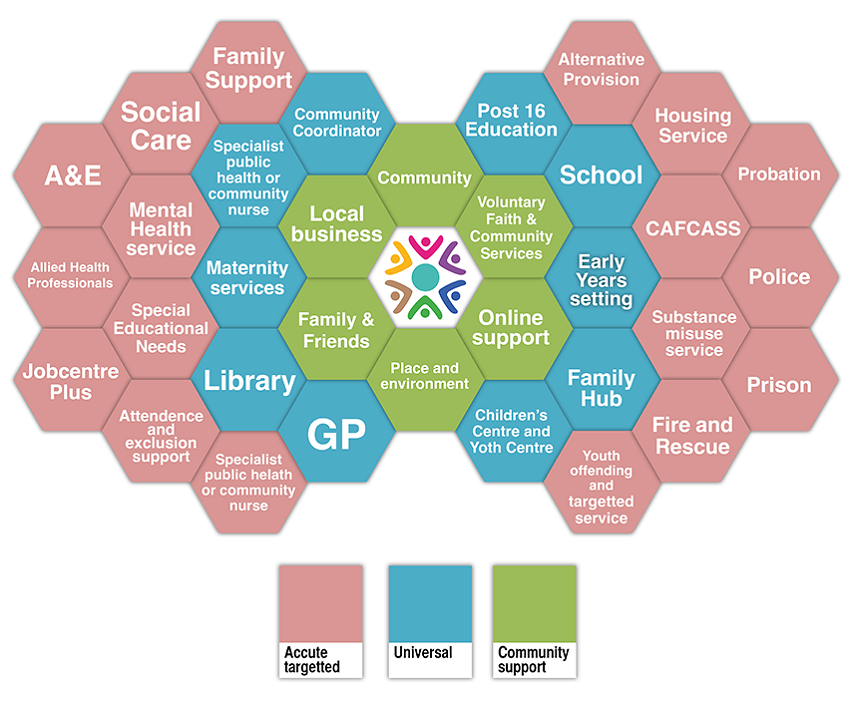
Family Hubs bring services together to work with families from conception, through childhood and into adolescents (0 to 19 years and up to age 24 years for some young people with needs arising from SEND) to deliver an integrated local offer.
Family Hubs should be seen as an umbrella term, not only physical buildings, to describe the collection of services working in a locality including more targeted services deployed with other services to support children and families’ needs.
If you think about any service that families may need then Family Hubs are designed to provide information and access to them - this could include a wide range of services ranging from day care and early learning to schools and alternative education, from midwifery and health visiting to mental health, and from advice on parenting to family support, adult learning and employment opportunities.
There are four Family Hubs locality areas (West, South, East and Keighley/Shipley combined) covering the Bradford District with a number of sites in each geographical area where services are delivered. Our main Family Hub sites and linked sites are located in areas of highest need in the Bradford District. These are coordinated to make best use of resources and space. Services should be accessible independently by families but also work together when a child, young person or parent/carer has an additional need or through an early help assessment and a Lead Practitioner to support multiple/more complex needs.
In Bradford district, every person engaging with children and families has a responsibility to support the delivery of effective Prevention and Early Help and to support the family to access appropriate services.
Improving school attendance is also everyone’s business. The barriers to accessing education can be complex, both within and beyond the school gates.
For our District’s most vulnerable children, regular school attendance is an important protective factor and the best opportunity for needs to be identified and support provided. Research has shown associations between regular absence from school and a number of extra-familial harms. This includes crime (90% of young offenders had been persistently absent) and serious violence (83% of knife possession offenders had been persistently absent in at least 1 of the 5 years of study).
Some pupils find it harder than others to attend school and therefore at all stages of improving attendance, schools and partners should work with pupils and parents to remove any barriers to attendance by building strong and trusting relationships and working together to put the right support in place at the right time. It must be a concerted effort across school staff, the trust or governing body, the local authority, and other local partners in open and honest relationships with family members.
Family Hubs/prevention and early help key partners
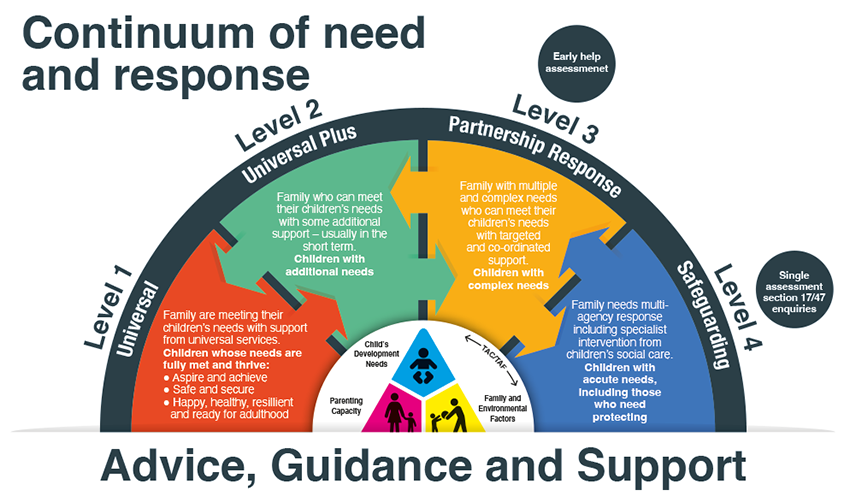
Our local Children’s Partnership has published guidance on levels of need aimed at every agency, statutory, voluntary, private and independent which works directly or indirectly with children, young people and families. The purpose of this guidance is to help agencies identify a child’s and their parents’ level of need and respond appropriately to provide “the right help, right time”. This covers universal, targeted and specialist support:
Why is prevention and early help important?
Prevention and Early Help is a high priority both nationally and at a local level. This is reflected in the Council’s Plan 2021-2025 as well as the Children and Young People’s Plan 2021-2022 (presently under review).
Locally, we are fully committed to going further in the national Family Hubs Start for Life programme.
Bradford District’s approach to Prevention and Early Help reflects the widespread recognition that it is better to identify and address difficulties early. This way, we can positively reduce demand on specialist or social care services.
‘Early identification of children and families who would benefit from a coordinated early help assessment supported by one worker, a named Lead Professional, is pivotal for improving outcomes for children and families as a whole family.’
The Independent Review of Children’s Social Care noted (and this is echoed in repeated feedback from families) the challenges that arise when support is fragmented, with no clear point of access or when there is a stigma associated with asking for help. The review finds that this has skewed services towards repeating assessments and crisis interventions more than early help.
This strategy supports the six strategic aims Children and Young People’s Plan set out below:
Good start, great schools
We want to give all our children and young people the best start in life by providing high quality early years education for all and creating a long term sustainable improvement in outcomes starting from the first 1001 days, school readiness and throughout their school journey
Safeguarding the most vulnerable and supporting families
Ensuring our most vulnerable children and young people are protected from harm, and that they and their families are provided with the services and support to enable them to secure their rights and maximize their potential to the fullest
Safer, sustainable and active
We want to ensure that the district is a place where children and young people feel safe and nurtured, where there is access to decent homes and accessible service are provided. A district where cultural diversity is celebrated and everyone can play an active role in their community
Better health, better lives
We want all our children and young people to enjoy the prospect of safe, long happy and fruitful lives by improving their health and social economic wellbeing.
Better skills, more good jobs and a growing economy
We want to ensure all our children and young people grow up in families free from the long terms affects that poverty has on life chances, and ensure they can make successful transitions into skilled and valued jobs and further/higher education
Participation and voice
We want to ensure that the voice of the children and young people is heard, and that they are actively engaged in the decision making process not only relating to their own lives but to the policies and strategies This strategy continues to address findings a local review held in 2019, particularly:
- The need to reinforce this is a collaborative approach and that Family Hubs are a collection of services not an individual service
- To increase the range of agencies undertaking Early Assessments and plans in light of this collaborative approach
- The need for a shared and central approach to data and tracking outcomes over time
- Increasing shared recording systems
- Increasing capacity for area based networking and partnership working
- Improving access to universal information, advice and guidance through a range of sources
Key facts
Two thirds of children who had their needs met through a coordinated Early Help approach, did not go on to present or re-present to Children's Social Care.
The Early Intervention Foundation report (2016) estimated a £17 billion national cost of late intervention.
The figure estimated to be spent by national and local services in Bradford is £165 million which equates to £311 per person.
The context across the Bradford District 2021
Bradford is not alone in experiencing unprecedented levels of challenge and complexity. This data clearly shows the scale of the challenges for our district, and why we must focus our ambition to provide high quality prevention and early help which will support families to reach their full potential whilst reducing pressure on expensive crisis services.
Whilst Covid-19 has exacerbated some of the challenges we face, it has also illustrated the many strengths of the partnership and what we can achieve when we work together.
- There are 6,185 children within the Bradford district who are open to Children's Social Care (as of 31/12/21)
- Rich in social and cultural diversity, ethnic minorities form a third of the population with more than 150 languages spoken within the district.
- We are the youngest district in the UK, with nearly one third of the population under 20
- 7 % growth in overall child population since 2016
- Bradford was one of the first places in the UK to be formally recognised as a ‘City of Sanctuary’
- 8% of children in year 6 are overweight or obese, this is the highest proportion in the region
- Recent studies show that fuel poverty affects 18.4% of households and 8% of people experience hunger because they did not have enough to eat.
- We have a strong committed network of voluntary and community organisations with around 130,000 volunteers
- We are the fifth most income-deprived area in the country. Some 266,000 people live in the poorest areas and nearly one third of our children live in poverty. In 2020, 38% of children under 16 lived in low income families, this equates to 60,000 children.
- Young people who are not in education, employment or training are at greater risk of a range of negative outcomes. Data shows Bradford who are not in education, employment or training is 6.1% compared to 5.5% nationally.
- Most recent data for persistent school absence (less than 90% attendance) shows that there has been an increase in absence and persistent absence across recent years. During the autumn term of 2021/2022 there were almost 21,000 persistently absent pupils in Bradford, out of a school population of 84,000 pupils – 24.5%. Due to the issues associated with pupils with persistent absence, this places a large number of Bradford children at risk of complex, harmful and potentially costly issues relating to poor education and social outcomes.
Our local partnership vision for prevention and early help delivered through Family Hub sites and networks
‘We want children and young people to have the time and space to enjoy their childhood and adolescent years, to grow up to be responsible citizens who contribute to the District, they should be supported to develop independent skills which allows them to become fulfilled adults.
This strategy supports the Council’s vision to promote economic growth and jobs and protect the most vulnerable. Children and young people are at the heart of all we do. They are essential to the District now and in the future.
All families need support from time to time. Prevention and Early Help co-ordinated through Family Hubs will work seamlessly to ensure all babies, children and families receive the information and support they need as easily and as early as possible.
We will work together to reduce inequalities and identify every child, young person and family with additional needs and ensure that they are supported by skilled and confident workers (and peers or volunteers) at the right time, in the right place, by the right people.
Relationships Matter to us all whoever we are and we will build on a families’ strengths and help families to develop skills and to build healthy relationships and social connections.
Our Partnership Principles
- Achieving positive outcomes for children and young people is a shared priority and at the heart of everything we do. We put children’s needs first and work to ensure they are getting the opportunities they deserve and inequalities are reduced.
- We will focus on the first 1001 days and prevention and health promotion, to avoid problems before they happen or from getting worse. We will identify needs early but we also recognise that it’s never too late for early help to make a difference.
- We will work together to deliver welcoming and accessible Family Hubs and to ensure a network of skilled and confident workers. We commit to make support available face-to-face, online and through outreach.
- We will co-produce local services with children, young people and families to recognise and build on their strengths. We will help them develop the skills to solve problems, make social connections and overcome difficulties.
- We will take a whole family approach and provide seamless support through a team around the family, sharing information openly in a timely way so that families only have to tell their stories once.
- We will adopt a shared approach to promoting healthy, open and honest relationships; within families, between families and the workers providing support and across our partnerships. How people get along with and support each other is key, particularly to support each other through times of change and/or difficulty. We recognize that fostering and building positive social connections are essential to everyone’s wellbeing.
- We want to develop our practices as a partnership so we can hear children, young people and families. We need to be able to act as their advocates and ensure that their voices and interests are being heard and understood.
How we will use evaluation and data to monitor success
We want to move from the perspective of data that is at the level of the service to a shared focused on the perspective of the child.
Partners from key services across Bradford District have joined together to co-produce a 0-19 Children and Young Peoples’ shared outcomes framework that measures important outcomes for children and young peoples’ safety, health and development. Plans are also shaped by an updated Families’ Joint Strategic Needs Assessment.
Our shared 0-19 outcomes framework:
- enables in-depth, locality based, needs assessment highlighting areas of inequality
- supports the tracking of the impact of interventions through improved outcomes over time
- acts as a catalyst to further develop a single shared child record across organisations where important information that is in the best interests of the care of the family can be shared across the services that are supporting them.
We have used this outcome framework to assess the needs of children aged 0-5 in each ward of the Bradford district to identify inequalities in outcomes and differences in needs for support across the wards.
We are expanding this needs assessment to look at children and young people aged 5-19 across the Bradford District.
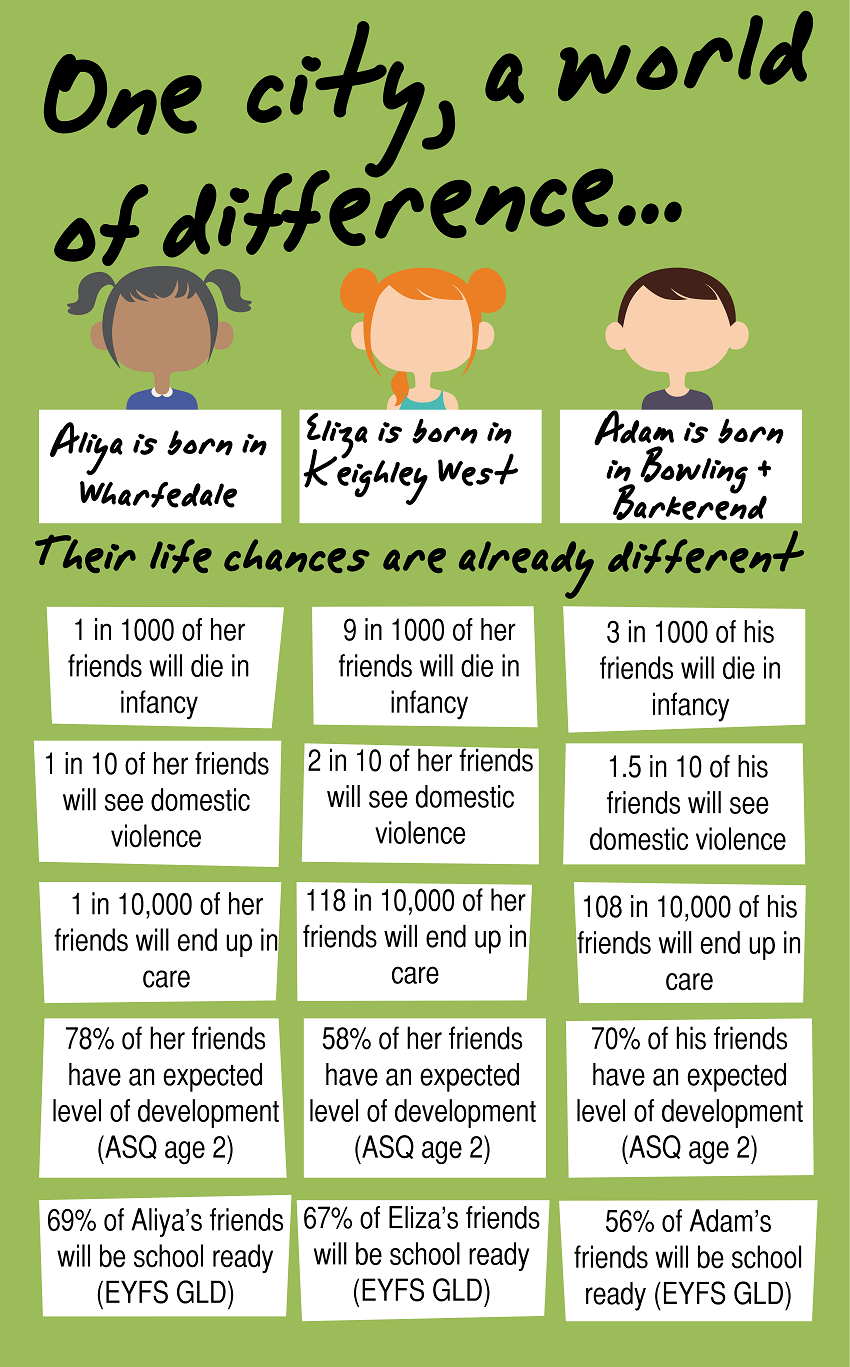
The needs assessment also demonstrated significant differences in outcomes for children between affluent and deprived areas, and varied needs based on the cultural and ethnic diversity of areas.
The findings of the needs assessment show that, when we look at data from the child’s perspective, we start to identify stark inequalities and differing patterns of needs that are not clear when using data from a single service or organisation
This work is now being used to inform Family Hub Start for Life plans and by local partnerships to highlight the importance of the prevention and health promotion, and to implement appropriate support in each locality. We will use the outcomes framework to evaluate the impact of these support provided.
What will success look like?
We will implement our local outcome framework so we can track over time:
- Start for life outcomes improved and inequalities reduce
- Good take-up of Early Years free childcare
- Good school attendance and behavior and contribute to reduce educational inequalities
- Children safe from abuse/neglect and exploitation and criminality
- Safe from domestic abuse
- Healthy family relationships and reduced parental conflict
- Support addressing mental health and/or substance abuse
- Financial stability is promoted
- Secure housing
- Families diverted from crime
- Families with children with SEND needs identified and support early
- Children, young people and families are proactively involved in shaping and evaluating service
- Family Hubs are accessible, welcoming, well used and help build social connections
Governance
This strategy is owned by the Prevention and Early Help Strategic Partnership (P & EHP). This group leads the governance arrangements for Prevention and Early Help work with children, young people and families and will ensure agencies work together effectively to meet the needs of children and families.
The partnership will have a good understanding of outcomes, the demand for services, the family experience of services and how to embed prevention and early help through Family Hub sites and networks locally.
The specific objectives for the P & EHP board can be found under the following work streams:
- Prevention and Early Help Ages 0-8
- Prevention and Early Help Ages 8 +
- Publishing the Start for Life offer/Information for Families
- Outcomes, data and evaluation
The Board’s members and its sub group must ensure close working across other local linked developments, for example, Domestic Abuse and Sexual Violence, looked after children and young people, Safeguarding, promoting children and young people’s mental wellbeing and Act as One.
Our priorities for 2022-2025
We are part of the national Family Hubs Start for Life programme. We have identified the following priorities for the next three years. We will develop a detailed delivery plan and review progress regularly:
- Relaunch our Family Hubs arrangements and ensure they are well known, welcoming and accessible. Including face to face, online, at wider local centres and home visiting/outreach. Support must be nearer, earlier and easier for families to access
- Launch and build area based Family Hubs networks involving family members and Third Sector and Education partners
- Expand and develop essential Start for Life services, targeted effectively when needed to reduce inequalities. Particularly peri-natal mental health and parent-child relationships, promoting home learning and school readiness, parenting support and infant feeding.
- Ensuring wider networks and support beyond Start for Life, for example, link to youth support, SEND, substance misuse, housing, debt and welfare advice and pathways into good work.
- Move from co-location of key teams in Family Hubs to integrated practices which support families earlier and more seamlessly including new area based single point of access.
- Develop and implement an integrated system Family Hubs workforce development plan focusing on understanding impact of adverse childhood experiences and promoting healthy relationships and resilience from pre-conception and beyond.
- Implement robust arrangements for evaluation and co-production and expand working with peer supporters and volunteers building on supporting the District to be a safe, green and active place to live, work and play.
- Harness the opportunities from the City of Culture to create an inclusive, creative environment for babies children and young people which celebrates the vibrant diversity of our district.
Priority 1
Relaunch our Family Hubs arrangements and ensure they are well known, welcoming and accessible. Including face to face, online, at wider local centres and home visiting/outreach. Support must be nearer, earlier and easier for families to access.
|
What is the issue we are trying to address? |
What are we going to do as a partnership? |
Who needs to be involved? |
What would success look like? |
Priority 2
Launch and build area based Family Hubs networks involving family members and Third Sector and Education partners.
|
What is the issue we are trying to address? |
What are we going to do as a partnership? |
Who needs to be involved? |
What would success look like? |
Priority 3
Expand and develop essential Start for Life services, targeted effectively when needed to reduce inequalities. Particularly peri-natal mental health and parent-child relationships, promoting home learning and school readiness, parenting support and infant feeding.
|
What is the issue we are trying to address? |
What are we going to do as a partnership? |
Who needs to be involved? |
What would success look like? |
Priority 4
Ensuring wider networks and support beyond Start for Life, for example, link to youth support, SEND, substance misuse, housing, debt and welfare advice and pathways into good work.
|
What is the issue we are trying to address? |
What are we going to do as a partnership? |
Who needs to be involved? |
What would success look like? |
Priority 5
Move from co-location of key teams in Family Hubs to integrated practices which support families earlier and more seamlessly including new area based single points of access.
|
What is the issue we are trying to address? |
What are we going to do as a partnership? |
Who needs to be involved? |
What would success look like? |
Priority 6
Develop and implement an integrated system Family Hubs workforce development plan including a focus on understanding impact of adverse childhood experiences and promoting healthy relationships and resilience from pre-conception and beyond.
|
What is the issue we are trying to address? |
What are we going to do as a partnership? |
Who needs to be involved? |
What would success look like? |
Priority 7
Implement robust arrangements for evaluation and co-production and expand working with peer supporters and volunteers building on supporting the District to be a safe, green and active place to live, work and play.
|
What is the issue we are trying to address? |
What are we going to do as a partnership? |
Who needs to be involved? |
What would success look like? |
Priority 8
Harness the opportunities from the City of Culture to create an inclusive, creative environment for babies, children and young people which celebrates the vibrant diversity of our district.
|
What is the issue we are trying to address? |
What are we going to do as a partnership? |
Who needs to be involved? |
What would success look like? |