Bradford District
Bradford District is home to more than half a million people, vibrant communities, innovative businesses and globally renowned education institutions. It is young and diverse, alive with energy, enterprise and goodwill with unrivalled potential, a growing pipeline of talent and exceptional cultural experiences.
With a growing population of 563,600 Bradford is currently England’s 5th biggest Metropolitan Authority. The population is forecast to reach over 570,000 by 2032. It is among the youngest places in the UK with over 22% of people aged under 16. The older population is also growing, especially the number of residents over 80 and 90 years old.
The district brings together city, suburbs, and the towns of Keighley, Shipley, Bingley, and Ilkley each with strong identities. It is urban, bustling, with award-winning public realm yet two-thirds of the district is rural with villages, beautiful landscapes, and open spaces on the doorstep.
This scale and multi-faceted diversity mean that the Council must represent, serve and understand an equally diverse range of interests, needs and expectations which has implications for resource allocation and the need for a comprehensive evidence base to inform decision making.
Bradford District: Big, Young, Diverse
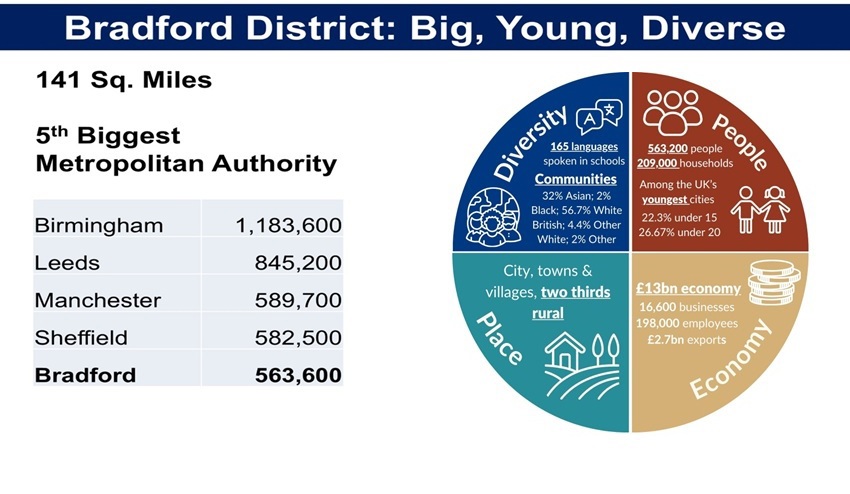
Bradford District is 141 Square Miles.
It is England's 5th biggest Metropolitan Authority.
- Birmingham: 1,183,600
- Leeds: 845,200
- Manchester: 589,700
- Sheffield: 582,500
- Bradford: 563,600.
Diversity
165 languages spoken in schools.
Communities
32% Asian; 29.4% White British; 5.6% Black; 4.4% Other White; 26% Other.
People
563,600 people. 209,000 households. Among the UK’s youngest cities: 22.3% under 15; 26.67% under 20.
Economy
£13bn economy. 16,600 businesses. 198,000 employees. £3.5bn exports.
Place
City, towns and villages, two‑thirds rural.
Asset rich
Bradford is at a clear moment of opportunity with unprecedented levels of development and once in a generation investment, and with momentum and prestige from its year as the UK City of Culture in 2025.
The district has already seen meaningful progress. Norfolk Gardens has created a vibrant green heart for the city. One City Park has delivered Grade A city centre offices, Darley Street Market is alive with food, culture, and events. Bradford Live has brought the old Odeon Cinema back to life as a venue that pulls crowds from across the North. In Keighley and Shipley, our Towns Fund projects are promoting skills, manufacturing, business growth and the visitor economy. These are the kinds of shifts that make people want to live, work, visit, and invest here.
The scale, diversity and productive potential of the district is significant and rooted in a range of key assets and investments that have been secured to drive further transformation across all neighbourhoods in the district.
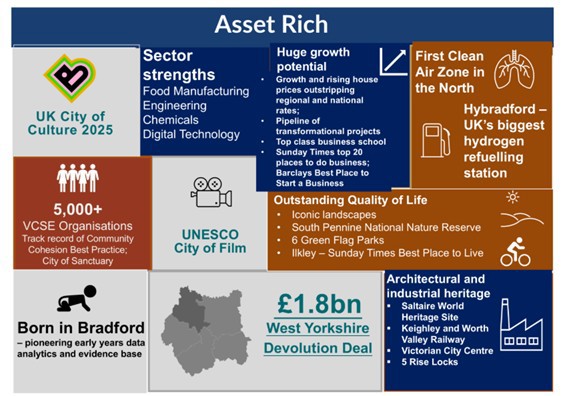
People
5,000+ VCSE Organisations. Track record of Community Cohesion Best Practice; City of Sanctuary.
Born in Bradford
Pioneering early years data analytics and evidence base.
Sector strengths
Food Manufacturing, Engineering, Chemicals, Digital Technology.
UNESCO City of Film
Bradford is UNESCO City of Film.
West Yorkshire Devolution Deal
£1.8bn
Huge growth potential
- Growth and rising house prices outstripping regional and national rates.
- Pipeline of transformational projects.
- Top class business school.
- Bradford places in top 20 places to do business;
- Barclays Best Place to Start a Business.
Air quality
- First Clean Air Zone in the North.
- HyBradford – UK’s biggest hydrogen refuelling station.
Outstanding Quality of Life
- Iconic landscapes
- South Pennine National Nature Reserve
- 6 Green Flag Parks
- Ilkley – Sunday Times Best Place to Live
Architectural and industrial heritage
- Saltaire World Heritage Site
- Keighley and Worth Valley Railway
- Victorian City Centre
- 5 Rise Locks.
Unlocking potential
To build a forward-looking economy that leads to change, all our residents must be able to capitalise on emerging economic opportunities. Unlocking opportunity so that growth reaches every part of the District, will require a relentless focus by the Council and all partners on addressing some significant challenges.
Challenges
Inequality and Deprivation
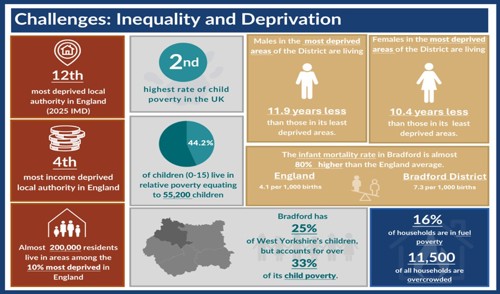
- 12th most deprived local authority in England (2025 IMD).
- 4th most income deprived local authority in England.
- Almost 200,000 residents live in areas among the 10% most deprived in England.
- 2nd highest rate of child poverty in the UK.
- 44.2% of children (0–15) live in relative poverty equating to 55,200 children.
- Bradford has 25% of West Yorkshire’s children, but accounts for over 33% of its child poverty.
- Males in the most deprived areas of the District are living 11.9 years less than those in its least deprived areas.
- Females in the most deprived areas of the District are living 10.4 years less than those in its least deprived areas.
- The infant mortality rate in Bradford is almost 80% higher than the England average. England: 4.1 per 1,000 births, Bradford District: 7.3 per 1,000 births.
- 16% of households are in fuel poverty. 11,500 of all households are overcrowded.
Economy and Skills
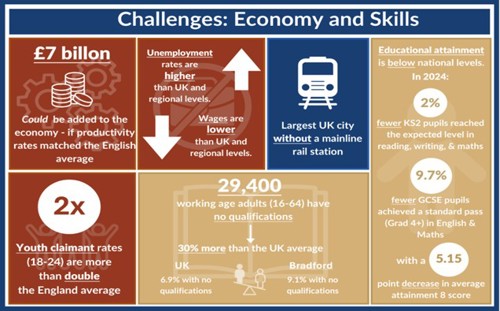
- £7 billion could be added to the economy – if productivity rates matched the English average.
- Unemployment rates are higher than UK and regional levels.
- Wages are lower than UK and regional levels.
- Largest UK city without a mainline rail station.
- Youth claimant rates (18–24) are more than double the England average.
- 29,400 working age adults (16–64) have no qualifications – 30% more than the UK average. UK: 6.9% with no qualifications. Bradford: 9.1% with no qualifications.
- Educational attainment is below national levels.
In 2024: 2% fewer KS2 pupils reached the expected level in reading, writing, and maths.
9.7% fewer GCSE pupils achieved a standard pass (Grade 4+) in English and Maths with a 5.15 point decrease in average attainment 8 score.