Bradford District: our people and places
Bradford District is alive with the energy, enterprise and ambition to be expected from one of the UK’s biggest, youngest and most diverse cities. The district is home to over half a million people, innovative, enterprising and globally connected businesses, inventive, forward thinking public services and a strong and vibrant VCSE sector. It is increasing in size and diversity and offers unrivalled potential for economic growth.
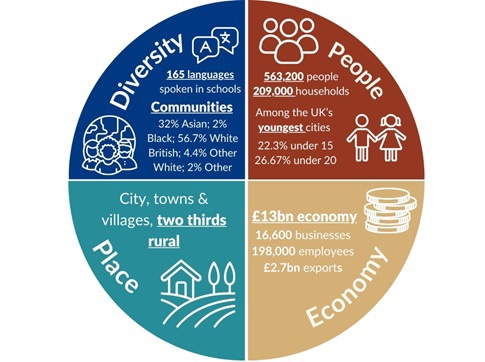
Big. Bradford is the country’s 5th biggest metropolitan district, home to over 563,600 people, 16,600 businesses, over 5,000 VCSE organisations and almost 16,000 volunteers. The population continues to grow, with the most recent forecasts predicting it to reach over 570,000 by 2032.
Young. 28% of the population is under 20 and 22.3% under the age of 16 so ensuring that this is a great place for children to grow up and succeed in is a priority.
Diverse. Bradford has a long history of migration, from within the UK, Europe, South Asia and the Caribbean and has more recently welcomed people from Syria, Afghanistan and Africa. Our diversity continues to increase with the proportion of people from ethnic minorities rising from 36.1% to 43.3% between 2011 and 2021 and 165 languages are spoken in our schools. Over 25% of people are of Pakistani heritage, the second highest proportion in the country.
Bradford district ‘s 141 square miles include a mixture of urban and rural, city, towns and villages including Bradford itself, Keighley, Shipley, Bingley and Ilkley and the tourist attractions of Haworth and Saltaire World Heritage Site. Two thirds of the district is rural.
The district’s scale and complex diversity of people and places requires local partners to serve, work, engage with, and represent a wide range of individuals, communities and businesses with multiple and differing needs and interests.
Home to a wealth of assets and opportunities
Bradford offers a wealth of assets and openings which collectively represent an unprecedented opportunity to generate growth at scale, improve health, wellbeing and quality of life and to provide everyone with chances to achieve their potential.
A £12 billion economy with 16,000 businesses including a strong and innovative manufacturing sector with strengths in in digital, advanced manufacturing, space and satellite technology, health innovation and sustainability.
Enterprise and entrepreneurship run through the district. High start-up rates, strong support for small businesses and an excellent work–life balance have seen Bradford named the UK’s most entrepreneurial city, ranked among the Sunday Times Top 20 places to do business, and recognised by Barclays as the best place to start a business.
Global reach defines our economy. Our businesses export £2.7 billion in goods and services each year, with 60% of exports going to non-EU markets, showcasing Bradford’s international connections and competitiveness.
Culture and creativity sit at the heart of our growth story. UK City of Culture 2025 will create a lasting legacy of participation and pride, strengthening the local economy and improving health, wellbeing and quality of life through creativity and shared experience.
Investment and transformation are reshaping our places. Major public and private investment has revitalised the city centre with high-quality public spaces, One City Park, Bradford Live, and Darley Street Market. A long-term pipeline of infrastructure projects will take this further, connecting Bradford to the mainline TransPennine Express line, delivering a new city centre station and West Yorkshire Mass Transit system. These projects will unlock the Southern Gateway, one of the UK’s largest regeneration opportunities, creating thousands of new homes, offices and jobs alongside the pioneering City Village low-carbon neighbourhood.
In Keighley and Shipley, Towns Fund projects are driving skills, business growth and the visitor economy, while Airedale Hospital’s inclusion in the national hospital building programme offers significant opportunities for health, jobs and regeneration.
As part of the £1.8 billion West Yorkshire Devolution Deal, Bradford plays a central role in delivering regional growth priorities through partnership with the West Yorkshire Combined Authority (WYCA).
Leading the way on sustainability, Bradford’s Clean Air Zone is improving health outcomes and reducing NHS pressures. Plans for a District Heat Network and the UK’s largest hydrogen refuelling station highlight our ambition to lead the transition to a clean, net zero economy.
The University of Bradford continues to help shape this future, driving innovation in sustainable growth, space technology and artificial intelligence, ensuring Bradford’s transformation is powered by knowledge, creativity and inclusive ambition.
Living Well is the Bradford district whole systems approach to healthy weight and wellbeing. It coordinates activity that contributes towards creating a district where it is easier to live a healthy and active lifestyle.
Born in Bradford is a unique health data analytics resource focussed on early years and evidencing effective preventative and early help interventions and maintaining Bradford’s longstanding reputation as a centre of pioneering social reform.
A large and vibrant VCSE includes 1489 registered Charities, Community Benefit Societies and Social Enterprises rising to over 5000 including unregistered charities, community associations, sports clubs and informal groups. VCSE turnover of the 699 largest groups in 2024-25 was over £176m and there are almost 16,000 registered volunteers.
The schools linking network pioneered in Bradford delivers excellence in building cohesion and links between communities.
Bradford is the north’s first RSA City of Learning and is home to some outstanding practice in skills and work with NEETs.
Green Space, Heritage and quality of life. Bradford District offers exceptional quality of life with outstanding landscapes and urban green space alongside stunning architectural heritage including Saltaire World Heritage Site, Bradford’s Victorian centre and Bingley’s five rise locks. The world’s first UNESCO City of Film, the District’s cultural assets also include the National Science and Media Museum, Alhambra Theatre, Kala Sangam Arts Centre, Bronte Parsonage, and Keighley and Worth Valley Railway which sit alongside a vibrant and growing contemporary cultural and culinary offer.
Bradford is a City of Sanctuary and a national innovator and leader on approaches to building community cohesion and bringing diverse communities together.
Collaboration is essential to achieving our ambitions. Bradford has a strong tradition of people and organisations- public, private and third sector - working together to improve lives for people in the district that goes back many years. Free school meals started in Bradford along with many other pioneering social changes. This spirit of working together to focus on difficult issues is a key asset in the district.
Challenges
Like most big post-industrial cities, Bradford has its challenges. These include high levels of entrenched deprivation and inequality and increasing child poverty. There are significant health inequalities between Bradford and the rest of the country and between different parts of the district. The economy is not operating at its full potential, challenges around transport connectivity act as a barrier to growth and there are issues with the quality of housing particularly within the private rented sector.
There is a need to go further and faster to raise educational attainment and skills and to secure improvement in outcomes for children. Population growth includes a forecast increase in the proportion of people aged 65 and over from 15.4% in 2022 to 17.9% in 2032 including increases among the 70-79, 80-89 and 90+ age groups with potential implications in terms of rising demand for health and care services and the ways these are delivered.
Inequality and deprivation drives demand and cost pressures on public services with limited resources making it increasingly important for local partners to work together to maximise the impact of all our collective resources on the issues that matter most so that we can realise our shared ambitions for the District - the size of the prize is immense – Bradford's potential represents an unrivalled opportunity for growth that can’t be ignored.
Inequality and Deprivation
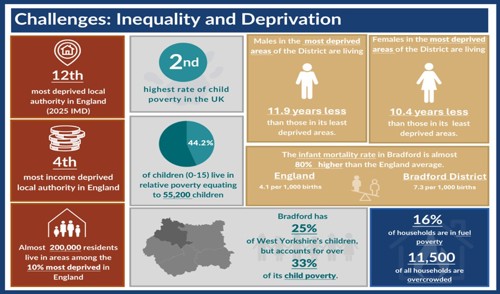
- 12th most deprived local authority in England (2025 IMD).
- 4th most income deprived local authority in England.
- Almost 200,000 residents live in areas among the 10% most deprived in England.
- 2nd highest rate of child poverty in the UK.
- 44.2% of children (0–15) live in relative poverty equating to 55,200 children.
- Bradford has 25% of West Yorkshire’s children, but accounts for over 33% of its child poverty.
- Males in the most deprived areas of the District are living 11.9 years less than those in its least deprived areas.
- Females in the most deprived areas of the District are living 10.4 years less than those in its least deprived areas.
- The infant mortality rate in Bradford is almost 80% higher than the England average. England: 4.1 per 1,000 births, Bradford District: 7.3 per 1,000 births.
- 16% of households are in fuel poverty. 11,500 of all households are overcrowded.
Economy and Skills
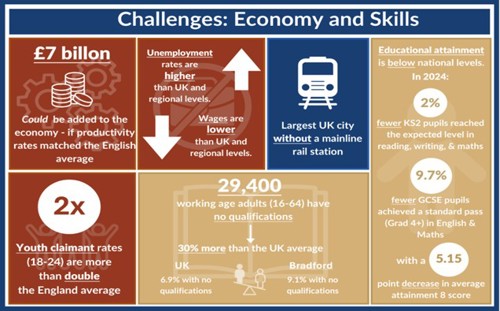
- £7 billion could be added to the economy – if productivity rates matched the English average.
- Unemployment rates are higher than UK and regional levels.
- Wages are lower than UK and regional levels.
- Largest UK city without a mainline rail station.
- Youth claimant rates (18–24) are more than double the England average.
- 29,400 working age adults (16–64) have no qualifications – 30% more than the UK average. UK: 6.9% with no qualifications. Bradford: 9.1% with no qualifications.
- Educational attainment is below national levels.
In 2024: 2% fewer KS2 pupils reached the expected level in reading, writing, and maths.
9.7% fewer GCSE pupils achieved a standard pass (Grade 4+) in English and Maths with a 5.15 point decrease in average attainment 8 score.